Trading case from Vikingen and Aktieutbildning.nu, June 16th!
Welcome to this week’s trading case from Vikingen and Aktieutbildning.nu
Buy recommendation from Aktieutbildning.nu the Trading Portfolio:
NVIDIA Corp. $205.34
Why?
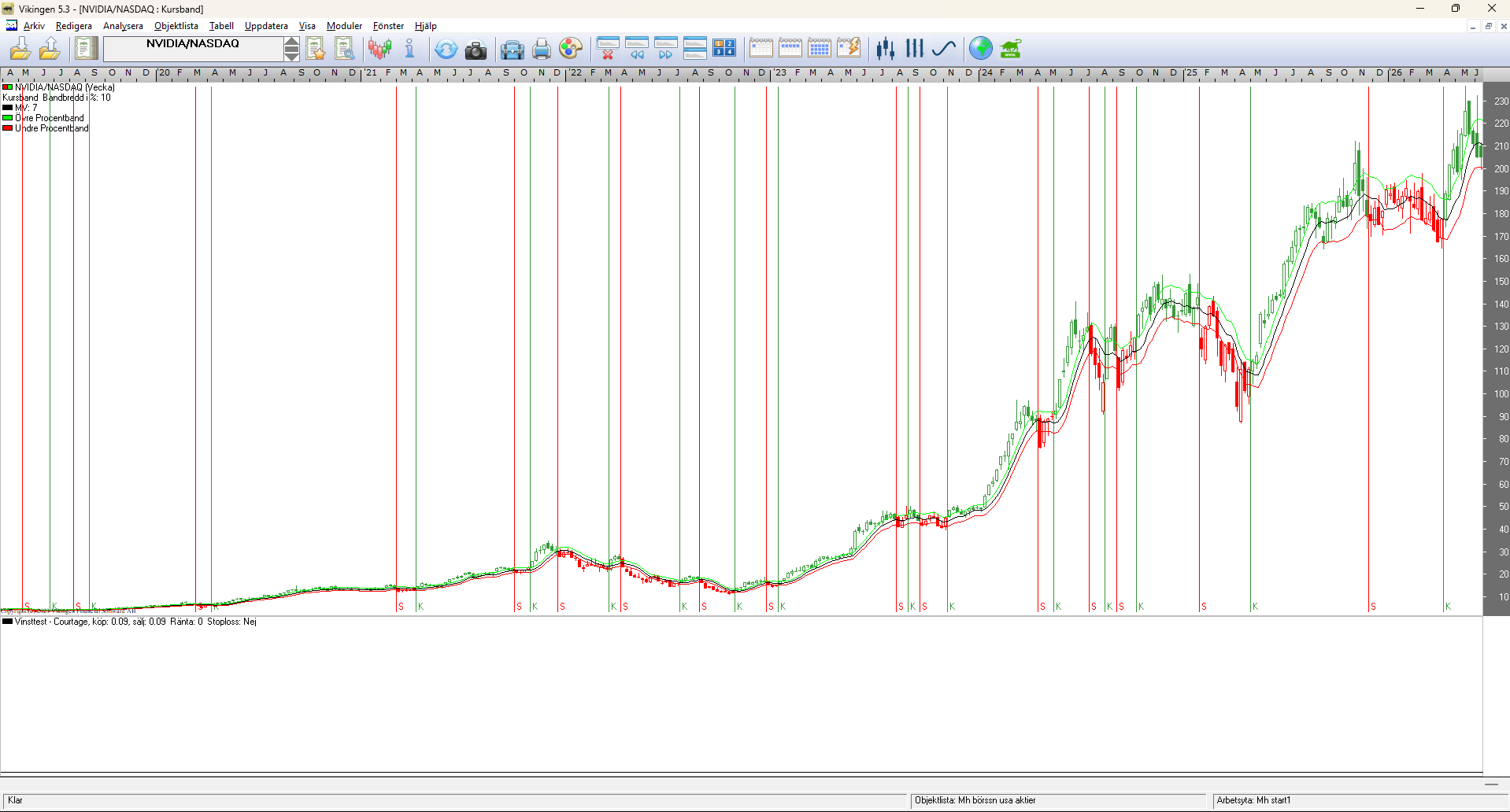
Technical analysis
(see also diagram below)
- A strong upward trend started many years ago. A pullback within a strong trend signals an uptrend and presents a good buying opportunity.
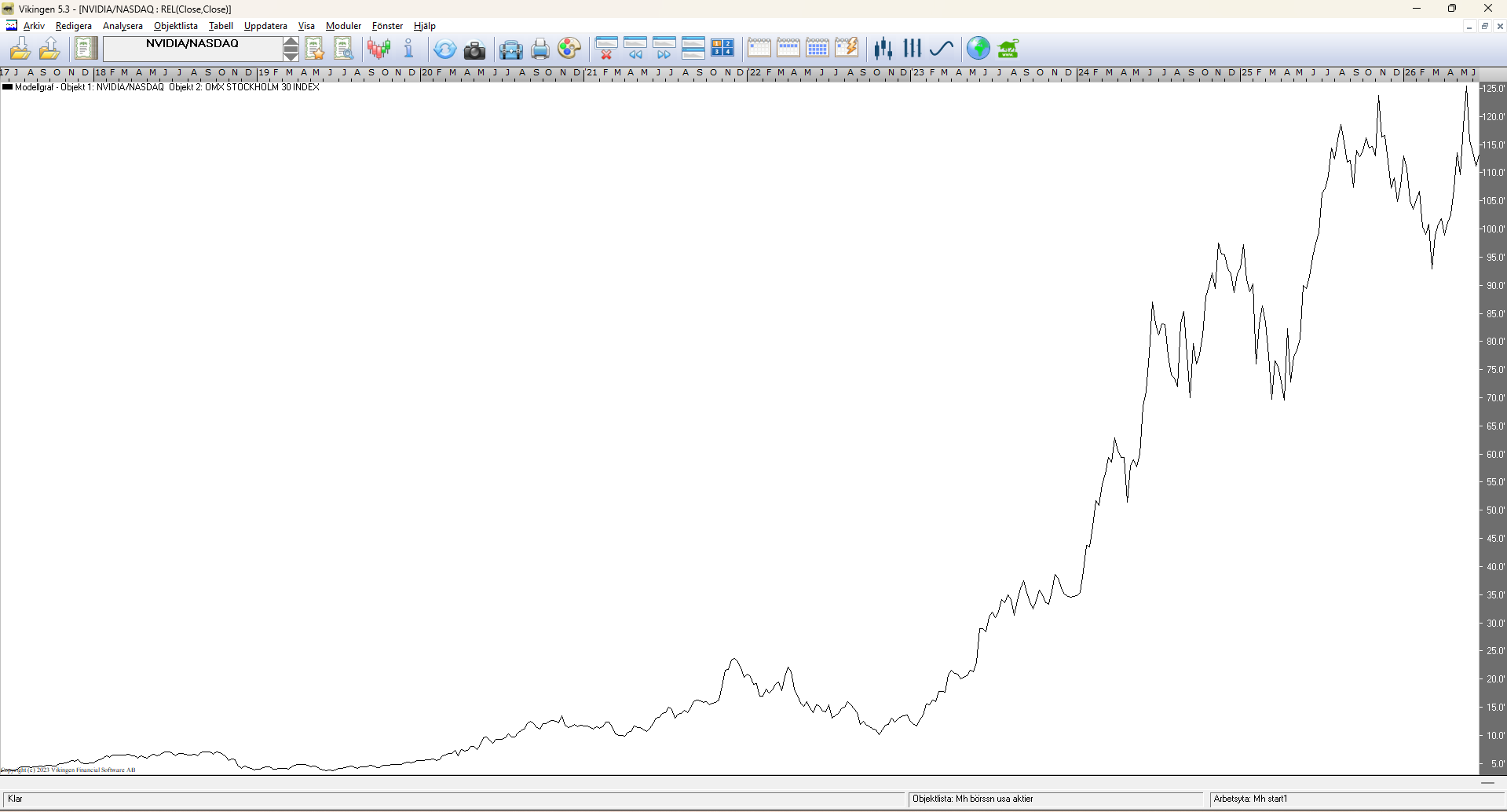
- The relative performance chart against the OMXS30 (and the S&P 500) continues to look strong.
- Vikingen’s BEST Model ( weekly and monthly), and other models are giving the “green” light and a buy signal.
Fundamental analysis
Below is an in-depth and well-founded SWOT analysis of Nvidia, structured to provide a clear, risk-aware, and macro-oriented picture of the company’s current market position as of June 2026.
NVIDIA has now surpassed $4 trillion in market capitalization and reported record revenue of $81.6 billion in the first quarter (FY27). This analysis cuts through the noise and focuses on the structural drivers.
Strategic Overview: NVIDIA Corporation (NVDA)
| Category | Core factor |
| Strengths | Monopoly position in the data center market (80%+), the CUDA software moat, and extreme pricing power (gross margin ~75%). |
| Weaknesses | Reliance on a single supplier (TSMC), extreme customer concentration among tech giants, and historically high valuation multiples. |
| Opportunities | “Sovereign AI” (government investments), Mag 7’s $700 billion CAPEX cycle (2026), massive growth in inference. |
| Threats | Hyperscalers’ custom-designed chips (ASICs), reduced ROI on AI investment, geopolitical risk surrounding Taiwan. |
Strengths
-
-
- The Institutional Moat (CUDA & Ecosystem): Nvidia’s true power lies not solely in silicon. For over a decade, its CUDA software platform has been the de facto standard for developers worldwide. This creates massive switching costs; it is not enough for competitors to build a faster chip—they must also convince millions of developers to switch their development environment.
- Unmatched margin power: The company consistently delivers gross margins of around 75%. This is fundamental proof of structural pricing power and near-total dominance in AI infrastructure.
- Innovation momentum: The transition from Hopper to Blackwell, and now the rapid rollout of the Vera Rubin architecture into full production, demonstrates an unmatched ability to execute on schedule and constantly raise the bar for performance, forcing the market to keep buying the latest technology to avoid falling behind.
-
Weaknesses
-
- High customer concentration: An alarmingly large portion of Data Center revenue (the segment generated $75.2 billion in Q1 FY27) is driven by a handful of “hyperscalers” (Amazon, Meta, Microsoft, Google). If any of these were to hit the brakes, it would immediately show up on the bottom line.
- Single-source risk in the manufacturing process: Nvidia is a “fabless” company and relies almost exclusively on TSMC in Taiwan for its chip manufacturing. This poses a binary geopolitical risk that cannot be mitigated through diversification in the short term.
- The valuation requirement: at its current market value, the stock is priced for absolute perfection. There is no margin for error regarding downward revisions to future forecasts or delays in the product line. Every quarterly report becomes a fine-tooth comb through which the market searches for the slightest sign of a slowdown in growth.

Opportunities
-
-
- The 2026 Investment Cycle (CAPEX): Tech giants are expected to invest up to $700 billion in capital expenditures this year. A very large portion of this capital is earmarked for AI infrastructure and flows directly into Nvidia’s order books.
- Sovereign AI (National Autonomy): The next major wave of demand will come from nations that are building their own independent AI data centers for security reasons. This diversifies Nvidia’s customer base away from the U.S. tech sector and opens up a massive, government-funded market.
- From training to inference: Until now, the heavy computational load has been associated with the training phase of large language models. Now that these models are to be deployed and used globally (“inference”), enormous amounts of computing power are required around the clock, which exponentially increases the addressable market.
-
Threats
-
- The “ASIC” trend and vertical integration: Nvidia’s largest and most important customers are investing tens of billions of dollars in developing their own custom chips (Google TPU, Amazon Trainium, etc.) in collaboration with companies such as Broadcom. Over time, the goal is to reduce dependence on Nvidia’s expensive hardware.
- AI Capex Fatigue: The single biggest fundamental risk is that end customers (ordinary businesses) will not begin to see a sufficient, measurable return on investment (ROI) from AI. If integration takes longer than expected, hyperscalers may be forced to cut back on their infrastructure investments to protect their own margins.
- Geopolitics and export restrictions: China’s data center market has effectively been eliminated as a source of revenue ($0) due to U.S. sanctions. Further escalation of the trade war or technology embargoes could close the door to additional markets or disrupt global supply chains for components.
Risk Analysis and Conclusion
NVIDIA is riding the wave of the most significant infrastructure expansion in modern technological history and enjoys a market position that few companies have ever held. Its fundamental growth and cash flows (S&P recently upgraded its credit rating to ‘AA’) give the company extreme financial strength, which is reflected, among other things, in its massive $80 billion share buyback program. For long-term management, the challenge lies in balancing the enormous structural growth against the concentrated downside risks, primarily linked to valuation, geopolitics, and the risk that tech giants’ willingness to invest will cool if AI profitability on the software side is delayed.

That was this week’s trading case with Vikingen and Aktieutbildning.nu!
Aktieutbildning.nu provides this advice for educational purposes!
Would you also like to have a Trading Portfolio?
You can find all the information about what Aktieutbildning.nu offers, as well as recorded webinars, here!
What’s the best buy right now?
Vikingen has the answers!
When you have Vikingen Exchange, Vikingen Trading or Vikingen Maxi you get the BEST model. All Vikingen programs help you make wise decisions when it’s time to buy and sell. You can easily follow trends, find good buying opportunities, monitor risks and stock market activity for your own investments.
Read about Vikingen’s different program packages and what is included here. For the Vikingen Mini, Stock Exchange and Trading programs, you can also buy the interesting add-ons you need most. See add-ons here. All add-ons and all models Vikingen offers are included in Vikingen Maxi.
Hope to see you again soon. Here you can check out free training courses on Vikingen’s programs Mini, Exchange, Trading, and Vikingen Maxi.
And don’t forget to tell your friends and colleagues to sign up for our newsletter. Vikingen has been around for 40 years and is constantly evolving. A new service will be launched soon!
Vikingen Financial Software reminds you that past performance does not always indicate future profits and that all trading is at your own risk.
Yours sincerely